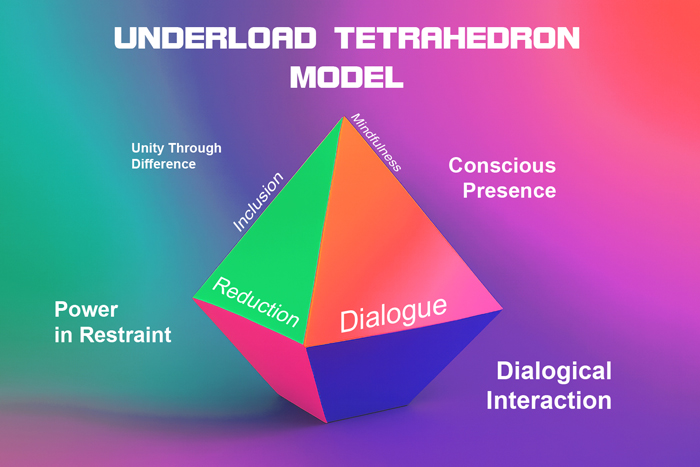
The Tetrahedron Model of Underload Drumming
The depicted model shows the Underload Tetrahedron in its complete form—including the area below the actual pyramid. Each of its faces represents an essential element of this approach: Dialogue, Inclusion, and Reduction together form the supporting base on which the entire concept is built. They stand for communication, belonging, and structural clarity—for the ability to open, connect, and organize musical and social spaces. Above these three faces, mindfulness rises as a connecting and balancing element. It unites the other principles, gives them direction and depth, and ensures that reduction does not become limitation, dialogue does not become superimposition, and inclusion does not become arbitrariness. Thus, mindfulness becomes the central principle that supports the interplay of all levels, making the tetrahedron a balanced, living model of conscious music-making. The lower area of the image is not mere decoration but an essential part of the representation. It acts like a soundboard on which the model rests—a visual grounding that connects the mental principles with real, physical, and sonic practice. This part symbolically represents the foundation of consciousness from which reduction, dialogue, inclusion, and mindfulness emerge. It serves as a reminder that Underload Drumming is not just a theoretical concept, but is physically experienced, heard, and felt in every moment of playing. This creates a harmonious overall picture: the tetrahedron as a conscious structural model—and below it, the base in which its principles are anchored.